


.png)
🐾 Piper's Blog: 10 Pest Myths Every Ohio Homeowner Should Stop Believing

Updated: Jul 25
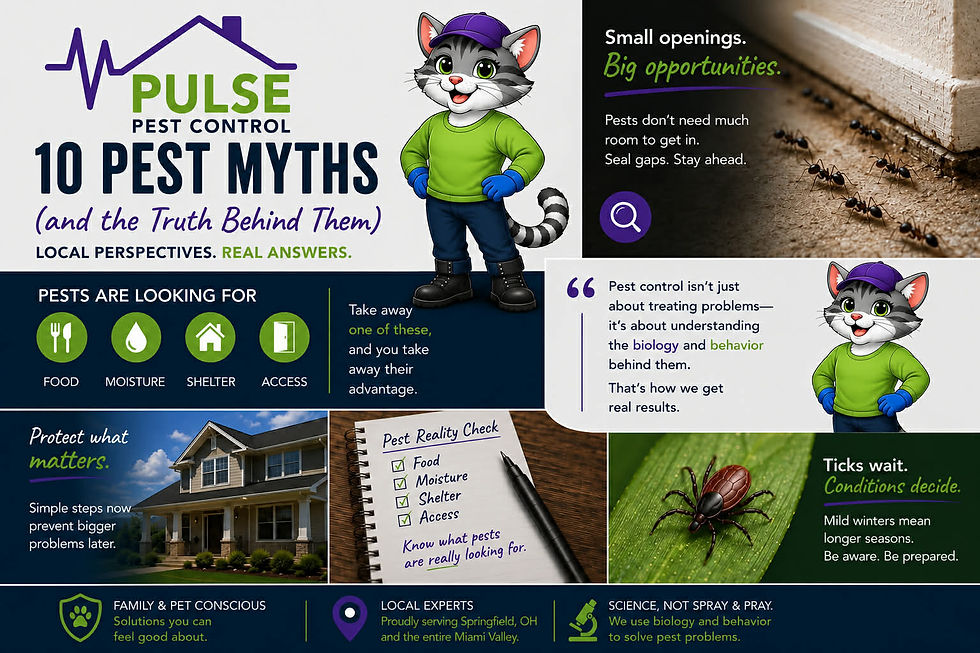
If there's one thing this job has taught me, it's that pests are surprisingly predictable.
People, on the other hand, are wonderfully creative when it comes to explaining them.
Some pest myths have been handed down for generations. Others spread across social media until they sound like established fact. The problem isn't just that they're wrong—it's that they point your attention in the wrong direction. When you're looking for the wrong cause, it's easy to miss what's actually happening.
One of my favorite parts of pest control is watching that moment when a homeowner stops memorizing pest facts and starts seeing patterns instead.
Let's look at ten myths I hear all the time around Springfield and the Miami Valley—and the better way to think about them. These Ohio pest myths often point homeowners toward the wrong cause, making it easy to overlook what pests are actually responding to.
Understanding Ohio Pest Myths
Myth #1: "If My House Is Clean, I Won't Get Pests."
Reality: Clean homes get pests too.
I understand why this myth exists. We've all seen ants around spilled sugar or flies around overflowing trash, so it's natural to connect pests with cleanliness.
But pests aren't grading housekeeping.
They're responding to opportunity.
A tiny gap under a back door. Moisture from a slow plumbing leak. Pet food left out overnight. Condensation around an air conditioner. These things often matter far more to a pest than whether the countertops were wiped down after dinner.
Some pests aren't even looking for food.
Bed bugs hitchhike wherever people travel.
Stink bugs are looking for a protected place to spend the winter.
Carpenter bees are looking for suitable wood in which to excavate nesting tunnels and provision brood cells for their offspring.
A clean home removes some opportunities, but it doesn't erase the reasons pests exist.
Here's the mental shift that changed the way I inspect homes:
Pests don't respond to cleanliness. They respond to food, moisture, shelter, and access.
Once you start looking for those four things instead of simply asking whether the house is clean, pest problems begin making a lot more sense.
Myth #2: "Cold Weather Kills All the Bugs."
Reality: Winter changes insect behavior. It rarely eliminates it.
If freezing temperatures wiped out insects every year, Ohio wouldn't have nearly as many species as it does.
Instead, insects have spent thousands of years figuring out how to survive our winters.
Some spend the winter as eggs tucked beneath bark or leaf litter. Others overwinter as larvae or pupae. Many adults seek protected places like tree cavities, wood piles, sheds, attics, or wall voids where temperatures stay far more stable than the open air.
Around here, one of the biggest clues is what happens in the fall.
When stink bugs, boxelder bugs, or Asian lady beetles gather on sunny exterior walls, they aren't enjoying the sunshine. They're using the warmth to help them find tiny openings that lead into protected places to overwinter.
Meanwhile, pests like German cockroaches and bed bugs don't experience winter at all. They live inside climate-controlled homes every day of the year.
The better way to think about winter is this:
It doesn't remove most pests. It changes where they spend their time.
Myth #3: "Ticks Die During the Winter."
Reality: Many ticks simply wait.
It's easy to assume ticks disappear once temperatures fall below freezing.
They usually don't.
Leaf litter, tall vegetation, and even snow create insulation that keeps temperatures near the ground much steadier than the air above.
Some species remain dormant until conditions improve.
Others, like blacklegged ticks, can become active during mild winter weather whenever temperatures rise enough for them to begin questing for a host.
That's why I don't think of tick season as something that starts and stops on a calendar.
I think of it as something that follows conditions.
If the weather gives ticks an opportunity to become active, they're ready.
Myth #4: "Spiders Come Inside Because They're Cold."
Reality: Most house spiders were already home.
Homes provide steady temperatures, protection from weather, and one thing spiders appreciate more than anything else:
Other arthropods.
Many of the spiders people find indoors have spent their entire lives inside.
So why do people suddenly notice them every fall?
Usually because mature males leave their webs and begin wandering in search of females. The spiders didn't suddenly appear.
They simply became easier to notice.
That's something pest control has taught me over the years:
Sometimes nothing changed except what became visible.
Myth #5: "Seeing One Cockroach Means There Isn't a Problem."
Reality: One sighting can tell you more than you think.
German cockroaches are experts at staying hidden.
They spend most of their lives behind appliances, inside cabinets, beneath sinks, and inside wall voids.
When populations grow, those hiding places become crowded.
That's when homeowners begin seeing them during the day.
Not because the insects suddenly became careless—but because the environment is forcing some of them into the open.
Now, not every cockroach means an infestation. Larger American cockroaches sometimes wander indoors from drains, crawlspaces, or outdoors.
That's why identification matters.
But here's what I always remind people:
The most important information isn't that you saw one cockroach. It's understanding why you saw that individual.
Myth #6: "Mosquitoes Breed in Tall Grass."
Reality: They rest there.
They begin life in water.
This is probably my favorite myth because it teaches one of the biggest lessons in pest control:
Where a pest spends its day isn't always where the problem starts.
Adult mosquitoes rest in cool, shaded vegetation because they lose moisture easily.
Their larvae, however, develop in standing water.
Sometimes that's a pond.
More often it's a clogged gutter, birdbath, bucket, flowerpot saucer, forgotten toy, old tire, or another container that holds water after rain.
When someone tells me mosquitoes are "coming from the grass," I usually start looking for water nearby.
The grass is the waiting room.
The water is the nursery.
Once you notice that relationship, your yard looks completely different.
Myth #7: "Spraying More Means Better Pest Control."
Reality: More isn't the goal.
Better is.
This myth makes sense because spraying is the most visible part of pest control.
People naturally assume more product equals more control.
But pests don't respond to volume.
They respond to biology.
Some products repel insects instead of eliminating the nest or colony.
Some only work when pests contact treated surfaces.
Some over-the-counter products never reach where pests actually live.
That's why a technician spends so much time inspecting before treating.
We're trying to understand the system before choosing the solution.
Good pest control isn't measured by how much pesticide was used.
It's measured by whether the treatment matched the pest's biology and behavior.
Myth #8: "All Bees and Wasps Are Aggressive."
Reality: Most simply want to be left alone.
Honeybees are busy collecting nectar.
Carpenter bees are focused on excavating nesting tunnels.
Paper wasps spend much of their time provisioning their nests and hunting insects.
Yellowjackets are different.
They're highly protective of enclosed nests and become much more defensive later in the season.
To me, that's the important distinction.
Not whether an insect can sting.
Many of them can.
The question is:
What is it trying to protect?
Understanding behavior is almost always more useful than judging appearance.
Myth #9: "If I Don't See Bugs, I Don't Have Bugs."
Reality: Most pests are far better at hiding than people realize.
Cockroaches stay behind appliances.
Bed bugs hide in seams and crevices.
Termites spend almost their entire lives inside wood or underground.
Ant colonies often remain completely hidden inside walls or beneath foundations.
One thing new homeowners often find surprising is that pest control rarely begins with finding the pest.
It begins with finding the evidence.
Frass.
Fecal droppings.
Shed exoskeletons.
Mud tubes.
Wood damage.
Repeated activity in the same location.
Pests leave evidence long before they introduce themselves.
Once you begin recognizing those clues, you stop waiting until a problem becomes obvious.
Myth #10: "DIY Always Saves Money."
Reality: Sometimes.
Sometimes it costs more in the long run.
There are plenty of situations where homeowners solve problems themselves.
Sealing entry points.
Correcting moisture issues.
Improving sanitation.
Eliminating standing water.
Those are excellent first steps.
But some pests don't simply need treatment.
They need understanding.
Bed bugs.
German cockroaches.
Termites.
Carpenter ants.
If the pest's biology and behavior aren't understood, it's easy to spend months treating symptoms instead of solving the cause.
To me, the question has never been DIY or professional.
It's this:
Which approach gives you the best chance of solving the actual problem instead of chasing it?
🐾 Piper's Closing Notes
The longer I work in pest control, the less I find myself looking for pests.
I find myself looking for what they're responding to.
Food.
Moisture.
Shelter.
Warmth.
Protection.
Once you start seeing those conditions, insects stop feeling random.
They start making sense.
And when something makes sense, it's much easier to solve.
So the next time you notice insects gathering on one sunny wall, mosquitoes hovering around the shrubs, or ants returning to the same tiny crack in the sidewalk, pause for a moment before reaching for a spray can.
Ask yourself:
"What are they responding to?"
More often than not, that's where you'll find the real answer.
That's also why we believe education is one of the most valuable parts of pest control. A treatment solves today's problem. Understanding helps you recognize tomorrow's before it grows into something bigger.
Until next time...
Stay curious.
— Piper 🐾


Comments